Talk of the Trees
 Tuesday, October 8, 2019 at 07:40AM
 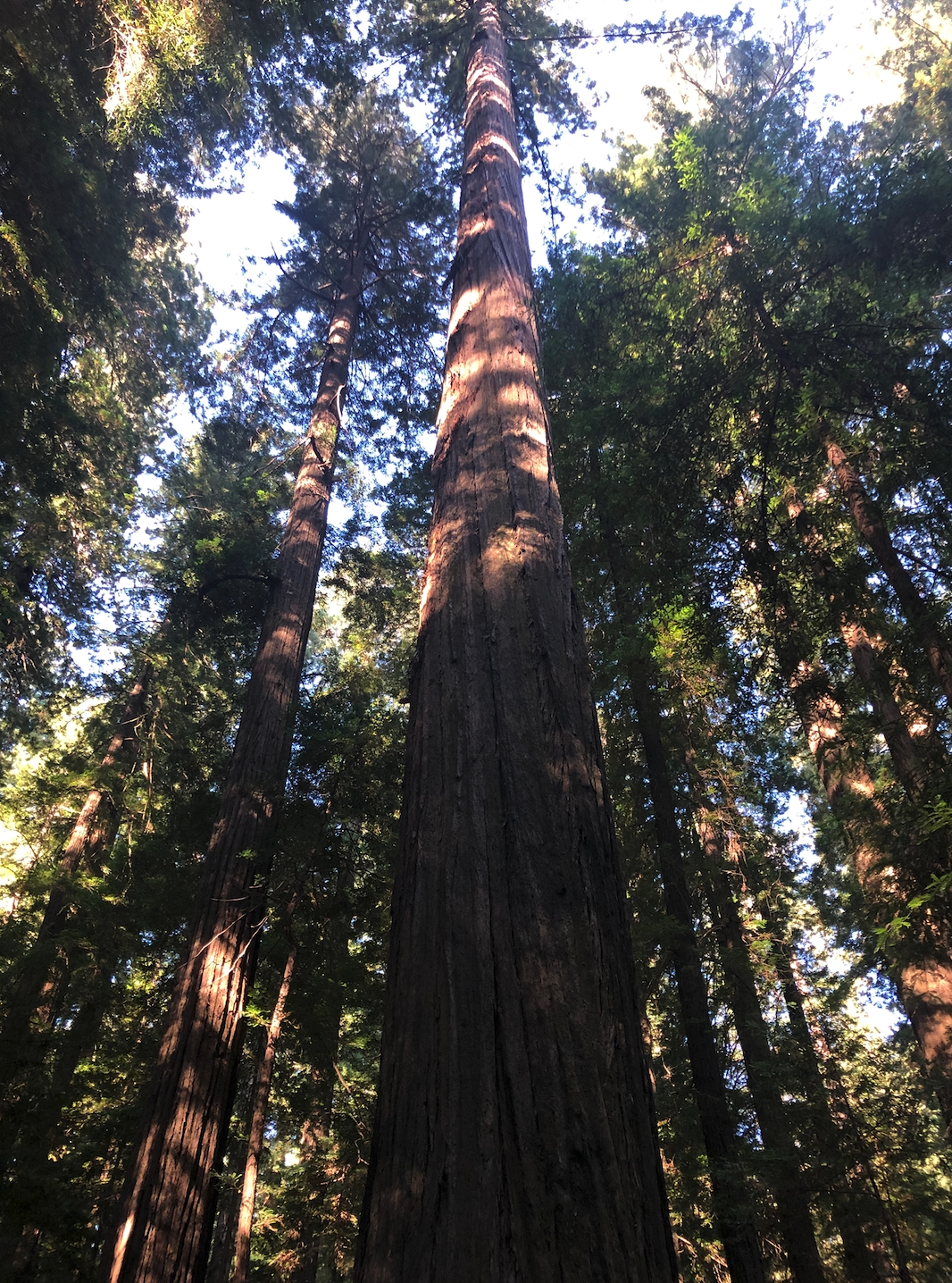 Photo by Chris KPIn 1969 Clint Eastwood told us in song that he “talks to the trees, but they don’t listen to me”. As it happens the trees were probably having far more useful conversations with each other, and it’s been going on for a long time.
Scientists have been exploring the ways plants communicate with each other for several decade now and some of the early evidence did not come from plants directly, but from animals. It can be easy to think of nature undisturbed by humans as being harmonious and stable. Of course it’s not that simple, the natural world is rich with endless systems networks and dynamic equilibria. There are complex relationships, cooperation and competition.
To avoid being eaten, plants sometimes develop physical barriers such as prickles and thorns. They might also develop chemical defences, such as unpleasant tasting compounds or even toxins in their tissues. These mechanisms can be very effective, but they only work for one plant at a time. Scientist, Wouter Van Hoven, noticed that giraffes would feeding on an acacia tree would stop quite abruptly, then move on to another tree, but not one close by. They would instead move to one upwind and further away. It turns out the first tree had produced tannins in its leaves, which made the leaves much less palatable. At the same time, however, the tree was emitting ethylene into the air which is detectable by other trees. These trees then increase the amount of tannin in their leaves.
Of course for this to happen at all, information (about predation, in the case above) often needs to be carried from one part of the pant another part. This is achieved with electrical signals. When something starts eating a plant, the plant can detect this and respond. It’s not just “something’s biting me” either. Plants are able to recognise different predators based on their different saliva and they will respond differently depending on who nibbling.
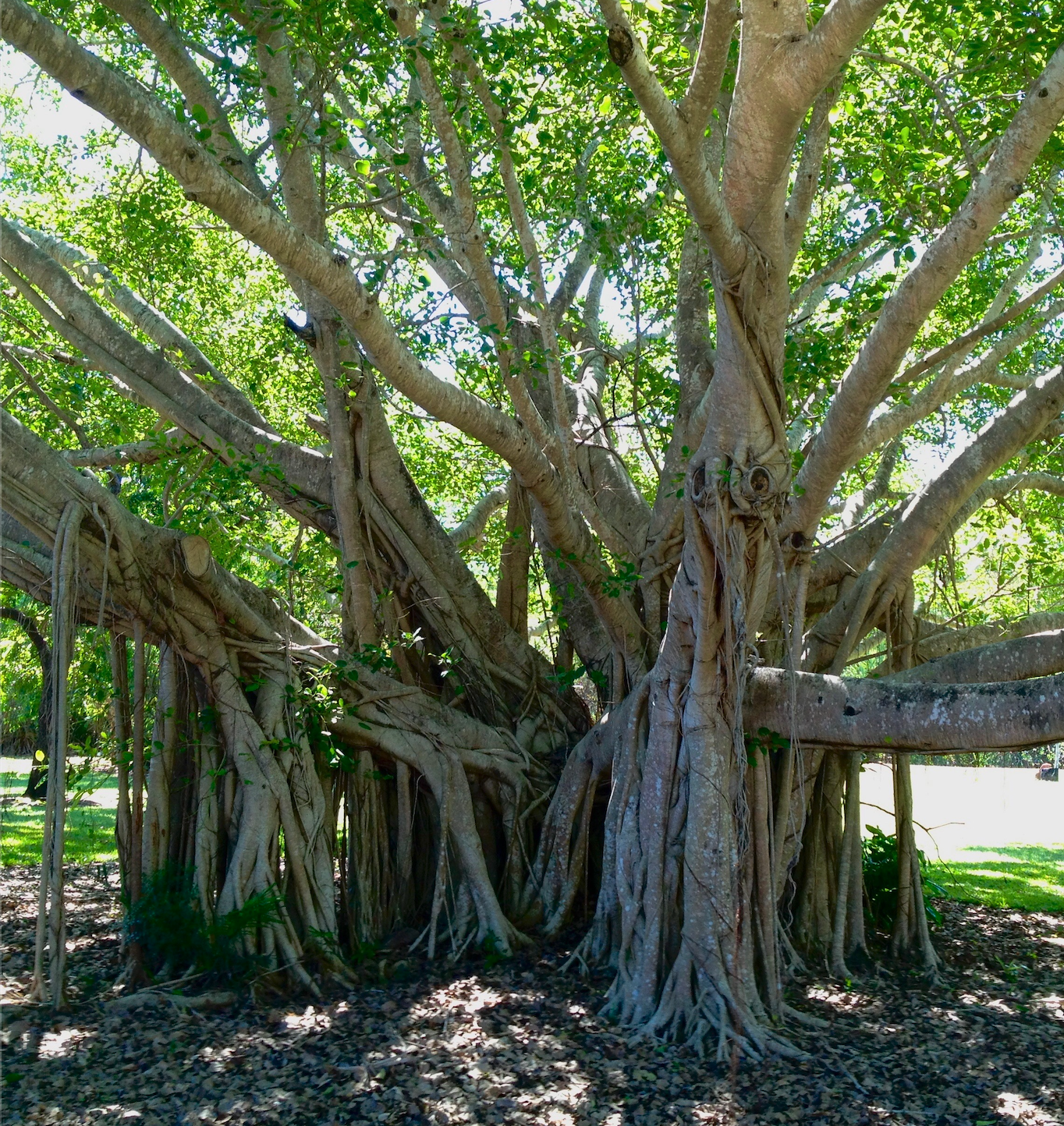 Photo by Chris KPWhen damaged, the tobacco plant releases green leaf volatiles (GLVs). These are the compounds that give freshly mowed grass its distinctive aroma. Up to now it was thought that the GLVs send out a signal chemical signal that attracts predators. The predators then eat the herbivores that are consuming the plant.
It turns out that when the tobacco species Nicotiana attenuata is attacked by tobacco hornworms (the caterpillar of stage of Manduca sexta), the chemical signal produced is different to the signal released if the tobacco plant is damaged in some other way.
Communication between plants, corresponds to the sensory capacity of individual plants. There is even evidence that plants can remember a situation they’ve experienced. Monica Gagliano coordinated a fascinating experiment in which they shone a blue light on pea plant. The plants would grow towards the light, because they use this light to photosynthesis. The plants experienced the light regularly. After a while they introduced a fan at the same time as the light, so the plants would experience the air from the fan as well as they light. This too they carried out regularly, and again the plants would grow towards the light. Then they stopped using the light and simply turned on the fan. The plants would grow towards the fan flow even when the light was not present, but only if they were “trained” to do so. This is plant equivalent of Pavlov’s dogs.
Plants are also connected via their roots, not just from below the ground to above the ground, but to each other. This might be via direct contact, but is commonly via a network of fungal threads or hyphae. There are a lot of fungal hyphae underground, intertwined with each other and with the roots of plants. They carry signals between plants and can even influence how nutrients are shared between adjacent plants. If you consider that the largest organism on earth is a fungus and that is covers and area more than 2,00 acres (more than 950 hectares), you can see how extensively they spread. With millions of years to refine their roles and relationships, it’s no wonder they’re so well connected with their plant friends.
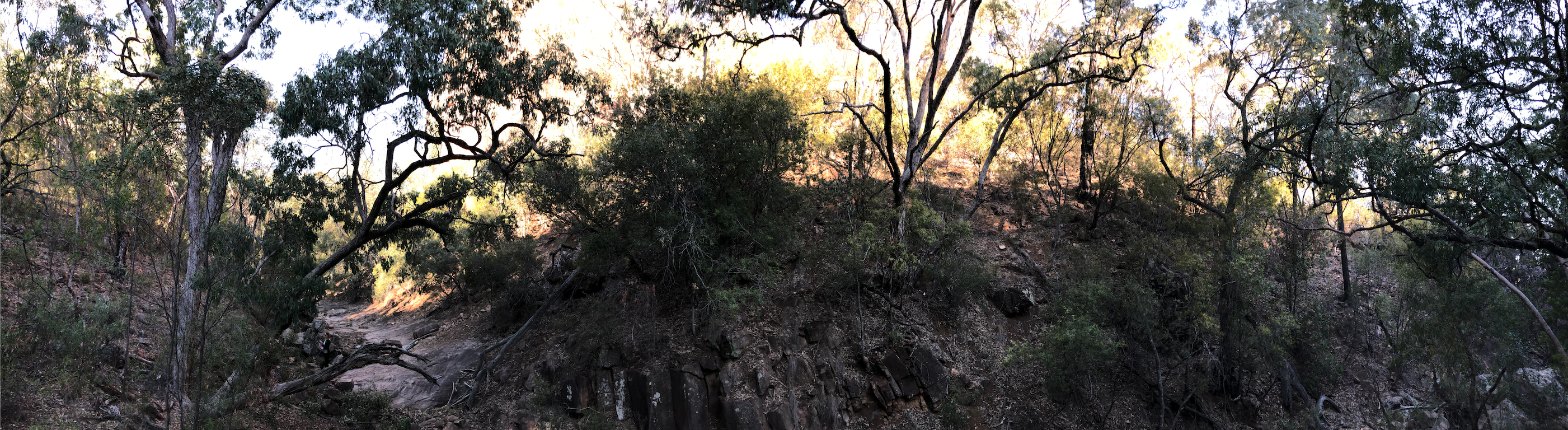 Photo by Chris KP
What's in a name? Ask Australia.
Monday, January 29, 2018 at 02:39AM I have always loved this photo. It was taken in 1961, but feels like it could easily have been taken earlier than that. The juxtaposition of a man on horseback herding sheep against a large – and unusual - manmade structure is very striking. It elicits a sense of either tension or an harmony between the old and the new, or perhaps just the inevitability of change. 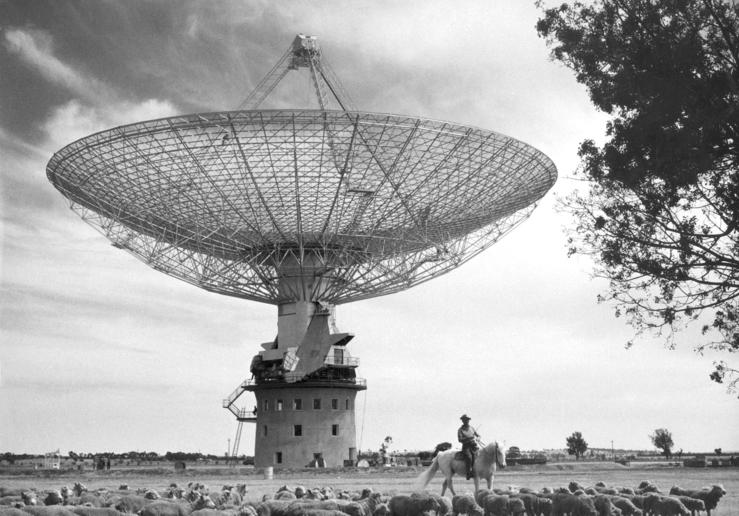
The man is AJ “Austie” Hem. It was AJ Helm who sold CSIRO 70 hectares of his 360-hectare property for the construction of a 64-metre radio telescope.
I have drawn people’s attention to this photo many times over the years and usually mentioned “AJ Helm” or “Austie Helm”, without much more thought. A couple of weeks ago it suddenly struck me how odd the nickname “Austie” is. Was it just a twist of Austin or something less obvious. Delightfully, yes.
It turns out that AJ Helm was born on 30 July 1915, to James and Beatrice Helm. Australia was at war and the Gallipoli campaign was underway. There was the constant need to raise funds for the war effort and to try to keep spirits high when good news must have seemed very rare. A Sydney Morning Herald article describes the public meeting at which it was decided to coordinate “a ‘great Australia Day’” to raise funds to “provide comforts and nursing assistance for sick and injured Australian soldiers and sailors”. The day set aside for this ‘Australia Day’ was 30 July, AJ Helm’s birthday.
He was given his father’s name, James, as his second name. In the spirit of the day, however, his parents named him Australia. AJ Helm was in fact Australia James Helm and Austie is short for Australia. So when Australia was looking for a site for a radio telescope, they purchased one from Australia.
I had the pleasure of visiting the Dish a few years ago and staying onsite while we performed a live web gig and recorded a music video. As you step outside and the kangaroos hop through the morning mist and the dish peers over the trees, there is a still a wonderful sense of calm and quiet achievement. I recommend it.
Sports Taxonomy
Tuesday, September 26, 2017 at 05:52AM Every day, across the globe, thousands of sporting teams take to the field, court, arena or course to compete in their chosen athletic pursuit. They have uniforms, mottos and songs, and they have names, nicknames or monikers. The Chargers, the Eagles, The Bears, the Flames, the 49ers. At first glance (in Australia at least) there seemed to be a preponderance of animal names, but which animals, from what classes, phyla and families? I crunched some numbers to find out.
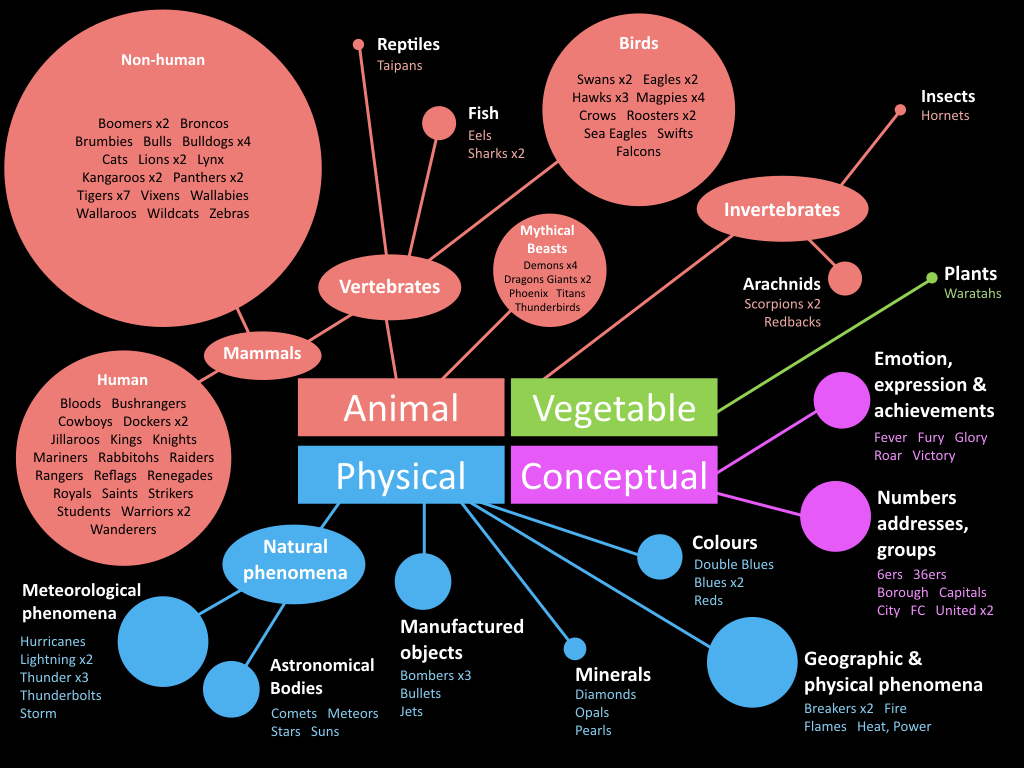
I explored a random selection of professional and semi-professional Australian sports teams from a range of sports (cricket, rugby union, rugby league, basketball, Australian Rules Football, soccer and netball) and my assumption that most teams have animal names was correct, but this was not as dominant a feature as I had expected. The graphic above shows how things panned out, beginning with a simple classification as Animal, Vegetable, Physical or Conceptual.
There are some repeated names (seven ‘Tigers’ and four Magpies for example), but notwithstanding that feature, about 21% of the names were non-human mammals; 16% were humans (e.g. Cowboys, Bushrangers, Wanderers); 13% were birds. Interestingly 8% were mythical creatures such as Dragons, Phoenix and Giants.
There were no amphibians and very few reptiles or insects. There were some arachnids (spiders and scorpions), but no marine mammals (although I note that the Frankston Dolphins will return to the Victorian Football League in 2018). Only one team has a plant-inspired name – the Waratahs. It seems that with a slightly broader-minded or more imaginative approach, there are plenty of options available in the biosphere. Conifers, algae (the Kingston Kelp, anyone?), bacteria, epiphytes, marine invertebrates (perhaps the Sea Haven Sea Stars or the Central Coast Krill) and fungi to suggest a few. There are also biological phenomena that might be fun to see. The Evolution, the Plague, maybe even the Mutants.
In my sample, meteorological phenomena represent 5% of team names (e.g Hurricanes, Lightning, Thunder) and numbers, addresses and groups make up similar proportion (City, Capitals, 36ers). Astronomical bodies, such as Meteors, Comets and Suns make up just over 3%.
Of course this is only a small data set and there are loads of amateur clubs that I have not considered (yet), but I now have a greater appreciation of what’s out there and what could be.
Creepiness and where to find it
Wednesday, October 12, 2016 at 02:17AM  Up much too close and personal with Mrs Danvers (Judith Anderson) in Alfred Hitchcock's 'Rebecca'Long before the creepy clown epidemic, we have all experienced the feeling of “creepiness”, sometimes triggered by a building or a location, often by a person. It might be a neighbour, a TV character or a stranger. Creepiness is quite distinct from fear. The uncomfortable sense that there might be something dangerous or unpleasant in the bushes inspires a completely different felling than that which you experience when you actually see the bear, or the guy holding the knife (or binoculars).
According to the authors of a new study, 'On the nature of creepiness', the uncertainty about whether a theat is real or not (or the ambiguity about what the thtreat might actually be), is central to the sense of creepiness.
Francis McAndrew and Sara Koehnke (Knox College, Illinois) were surprised that, despite the widely accepted experience of creepiness, there were no previous scientific studies exploring the condition. They collated more than 1,300 responses to an online survey about perceptions of creepiness. They found that males are much more likely to be creepy than females and that females often perceive a sexual threat from a creepy person. They also noted that some professions predispose their practitioners to perceptions of creepiness, notably clowns, taxidermists, sex shop owners and funeral directors.
Funeral directors are almost certainly an integral part of a modern economy. Arguably sex shops are too and most people would recognise the scientific benefits of taxidermy. I suspect, however, that most people are uncomfortable with excessive exposure to sex and death (especially with strangers) so people who choose these professions might appear to have slightly different norms to most people, hence a degree of discomfort.
 Creepy clown, image by GabboTThen there’s clowns. They look similar to the rest of us, but their emotional expression is disarmingly simplified and usually more extreme, and their behaviour clashes with many social rules. This is the very reason clowns can be entertaining – they are recognisably human, but their behaviour moves beyond socially acceptable boundaries, making them a target for ridicule. They can help us embrace silliness and perhaps make us feel comparatively clever and erudite. Their tomfoolery reinforces the strength of our social rules. The other thing about clowns that might make them especially creepy is that there is clearly someone under the makeup or mask. There is something unseen or unclear, tapping into the concept I described earlier of ambiguity or uncertainty of danger. There’s an interesting article on the history and psychology of clowning in the Smithsonian magazine.
McAndrew and Koehnke identified several characteristics of creepiness, including having unkempt or greasy hair (‘The Ring’, anyone?); having a peculiar smile (e.g. the Joker); very pale skin (like most clowns, Voldemort and Edward Scissorhands); licking ones lips frequently; standing too close to people; and laughing at unpredictable times (e.g. Max Cady).
 The Child CatcherI remember being completely freaked out by Robert Helpman’s Child Catcher in ‘Chitty Chitty Bang Bang’, who employed several of these features.
The study found that hobbies that are seen as a bit creepy include collecting dolls or body parts such as teeth, bones, or fingernails, as well as anything that involved some variation of watching, following, or taking pictures of people. Agreed.
Most respondents (nearly 60%) to McAndrew and Koehnkes’ survey said that they thought creepy people did not know they were creepy. A further 32% were “unsure”. So, perhaps we should cut creepy people just a little bit of slack. Perhaps not.
The study appears in the journal New Ideas in Psychology.
creepiness, creepy, psychology, science Will our plastic world collapse?
Sunday, October 11, 2015 at 07:03AM We’ve had plastics for more than a century. In that time we have identified an ever-expanding list of uses for them and a forever increasing number of different types (although not necessarily in that order). One of the most important practical characteristics of most plastics is that they last. Plastics are not easily damaged by water or air. Microorganisms do not commonly – or readily - break down plastics either and that is a problem.
From the myriad of common plastic items comes a tide of refuse. Shopping bags, food wrappers, drinking straws, soft drink bottles and cosmetic microbeads are distributed far and wide by people water and wind.
None us have never known a time without plastics, but a little over a hundred years is not even a blink of an eye in evolutionary time. Microorganisms simply have not had time (and perhaps reason) to evolve ways of breaking down the vast bulk of plastics. Microorganisms, however, reproduce quickly and there is more some evidence that things might be changing. More . . .